
News
2026
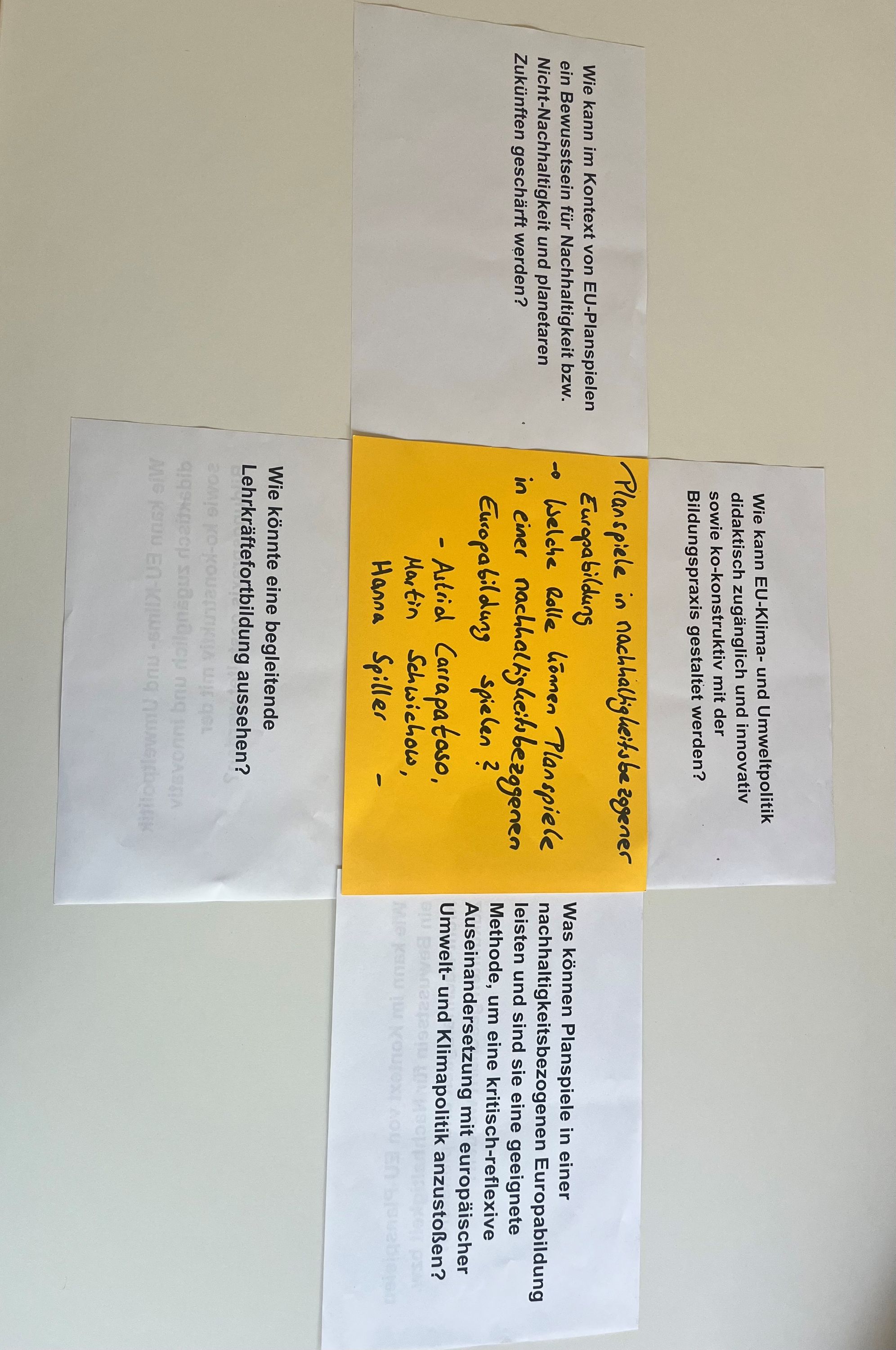
How can education contribute to a sustainable society in the face of the climate crisis? And what challenges does the escalating ecological crisis pose for education and the field of educational science itself? These and many other questions were addressed at the conference “Education in the Climate Crisis and the Climate Crisis of Education,” hosted by the working group “Sustainability, Non-Sustainability, and Planetary Futures” of the German Society for Educational Research.
In addition to many engaging panels and keynote speeches, the Barcamp format provided an interactive space for exchange at the end of the three-day conference. In this open event format, there is no fixed agenda. Instead, participants contribute their own topics, questions, and experiences and shape the individual sessions together. This creates spaces for discussion, networking, and the development of new perspectives.
EUTEG organized a Barcamp on the topic “Simulation Games in Sustainability-Related European Education.” The focus was on how European climate and environmental policy can be taught to students in a way that is understandable, interactive, and encourages critical reflection.
EU environmental and climate policy plays a central role in addressing the climate crisis. At the same time, European regulations are often complex and have so far rarely been addressed in a concrete and participatory manner in the school setting.
At the Barcamp, participants discussed the opportunities and challenges associated with using simulation games for sustainability-focused education about Europe. Among other things, the discussion focused on how complex European climate and environmental issues can be made accessible from a pedagogical perspective. The exchange with the participants provided new perspectives and concrete ideas for the project’s further development.
For EUTEG, the conference offered a valuable opportunity to combine its own approaches with perspectives from academia and educational practice, to reflect on existing ideas, and to advance the further development of the simulation games and teacher training programs.
On July 20, the ESD Network Forum took place in Stuttgart as a festival under the theme “Change as an Opportunity—Courage for the Adventure of the Future.” Over 300 stakeholders from the field of Education for Sustainable Development (ESD) came together to network, exchange experiences, and jointly generate ideas for the future.
EUTEG was represented with an information booth at the “Market of Opportunities,” where numerous ESD initiatives, projects, and organizations showcased their work. The market provided an ideal opportunity to present our project, engage in conversation with interested visitors, and establish valuable new contacts.
The festival also featured a varied program of panel discussions, workshops, short presentations, and interactive hands-on activities. During a panel discussion, Baden-Württemberg’s Minister of the Environment, Thekla Walker; Minister of Education and Cultural Affairs, Andreas Jung; Bernd Schwarz from the Federal Ministry of Education, Family Affairs, Senior Citizens, Women, and Youth; and Dr. Roman Luckscheiter, Secretary-General of the German UNESCO Commission, discussed, among other topics, the importance of education for sustainable development and its role in the new legislative period.
We are delighted to have been part of this inspiring festival. The exchange with dedicated stakeholders from the ESD network has once again demonstrated how important collaboration and networking are for jointly advancing sustainable development.
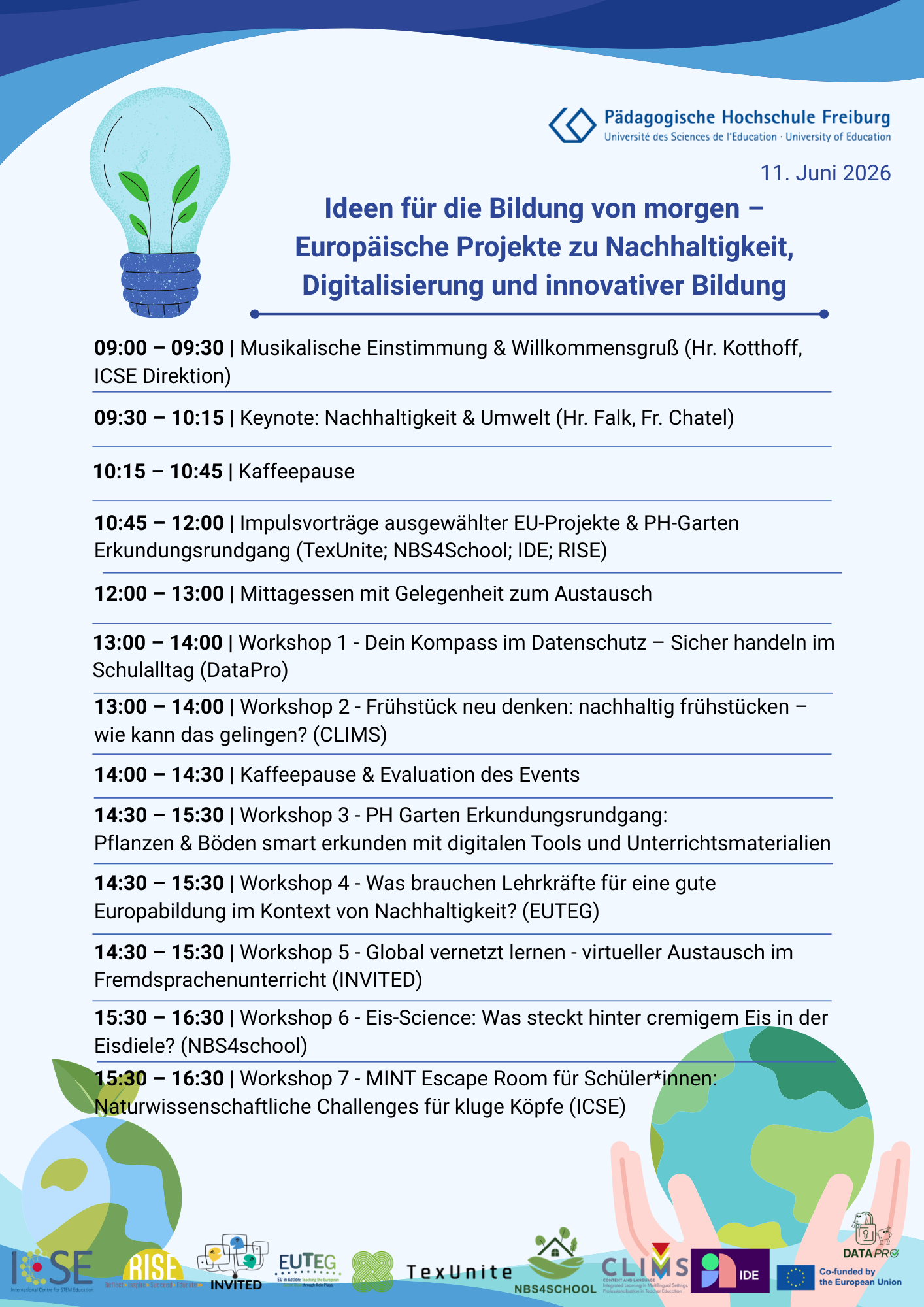
On June 11, 2026, the EUTEG project took part in the professional development day titled “Ideas for the School of Tomorrow: European Projects on Sustainability, Digitalization, and Innovative Education,” organized by the International Center for STEM Education (ICSE) at the University of Education Freiburg.
The event focused on current challenges and opportunities in the areas of sustainability, digitalization, and future-oriented education. Following opening remarks by Prof. Dr. Kotthoff and a keynote address by Prof. Dr. Falk, the professional development day offered numerous opportunities for exchange among teachers, education stakeholders, and European projects.
EUTEG presented its work through a poster presentation. In addition, we led the afternoon workshop titled “What Do Teachers Need for Effective European Education in the Context of Sustainability?” Participants gained insights into European climate and environmental policy as well as the initial ideas developed within the project regarding simulation games and teacher training. During the group discussion, challenges, needs, and opportunities related to European education and the use of simulation games were also discussed.
We would like to extend our special thanks to ICSE for organizing the event and for giving us the opportunity to present EUTEG as part of this multiplier event.
As part of the project, expert interviews have been conducted over the past few months on two key policy areas of the European Green Deal: the LULUCF Regulation and the Ecodesign for Sustainable Products Regulation (ESPR).
The aim of the interviews was to gain in-depth insights into European decision-making processes and to better understand the political dynamics behind the two regulations. The focus was particularly on the implementation process in Germany within the context of European decision-making processes, stakeholders, and lines of conflict; the evaluation and effectiveness of the regulations; as well as the relevance to everyday life and the applicability of both topics for schools and classroom instruction.
The interviewees were experts with specialized knowledge of LULUCF and ESPR or ecodesign, familiarity with European legislative procedures, and, in some cases, direct experience in EU political or consultative processes.
The findings form an important basis for further project work. Together with a literature review and document analysis, which will now be developed in the coming months, they will be incorporated into the creation of realistic role-playing scenarios on EU legislative procedures. The goal is to introduce secondary school students to European political processes in a practical and interactive way.
Our EUTEG project will participate in the Multiplier Event organized by the International Centre for STEM Education (ICSE) at the University of Education Freiburg on June 11, 2026. The event brings together stakeholders under the theme “Ideas for the School of Tomorrow: European Projects on Sustainability, Digitalization, and Innovative Education.”
As part of the event, EUTEG will offer a brief project presentation as well as its own workshop. Under the title “What Do Teachers Need for Quality European Education in the Context of Sustainability?”, participants will gain insights into European climate and environmental policy. The workshop provides a space for exchange, discussion, and networking around innovative educational approaches and European cooperation.
We look forward to presenting EUTEG at the Multiplier Event and engaging in conversation with interested participants.
Further information about the event can be found here:
Multiplier Event des ICSE
On April 27, the EU project EUTEG officially launched with a virtual kick-off meeting. The aim of the meeting was to bring together key stakeholders from various fields and facilitate an initial exchange of experiences, perspectives, and potential contributions to the project.
At the start, project leader Prof. Dr. Astrid Carrapatoso welcomed the participants and introduced project coordinator Hanna Spiller and student assistant Franka Back. The second project leader, Prof. Dr. Martin Schwichow, is currently on parental leave.
After a brief round of introductions, the project and the objectives of the meeting were presented: gathering expertise, experiences, and ideas for further content development, as well as discussing potential formats for cooperation and participation. Subsequently, the participants discussed, in particular, existing approaches in teacher training seminars and professional development programs for teachers, as well as simulation exercises.
In addition, an initial timeline for the project was presented. In this context, the next steps and key deadlines were discussed, and participants jointly explored opportunities for further collaboration. The focus was on questions regarding the specific structure of the collaboration: How can it be structured? What resources are available? And what are the expectations associated with participation? A central goal of the project is to ensure a strong practical focus. The collaboration should therefore take place on an equal footing and in a co-constructive manner: The goal is to jointly identify and further develop needs and ideas from the field. The primary responsibility for project implementation lies with the project team, while regular exchange sessions are planned at selected times. Additionally, there is always the opportunity to provide feedback or contribute one’s own ideas to the process.
The one-hour meeting already provided numerous valuable insights and suggestions for the project’s future work. We would like to sincerely thank all participants for their commitment and look forward to continuing the exchange as the project progresses, as well as to jointly developing suitable formats. Furthermore, we welcome dialogue with other interested parties and are always happy to receive suggestions and ideas.
Instagram & LinkedIn
EUTEG had the opportunity to introduce itself on the PH Freiburg Instagram profile!
Check out the Reel for a brief introduction:
https://www.instagram.com/reel/DZpUQTyPCzt/?utm_source=ig_web_copy_link&igsh=MzRlODBiNWFlZA==
On LinkedIn:
On July 20, 2026, the EUTEG project had the opportunity to participate in the 5th “BNE-BW 2030” Network Forum. Under the theme “Change as an Opportunity—Courage for the Adventure of the Future,” there was a lively discussion about the future of ESD. In addition, EUTEG had the opportunity to set up a project booth at the “Market of Opportunities,” which led to exciting conversations with a wide variety of stakeholders from the fields of education and sustainability.
You can find further insights here: