Doctoral Students’ Council
The University of Education Freiburg values the interests of its doctoral students. Established in 2015, the Doctoral Student Council promotes exchange and networking, and serves as a mouthpiece.
All doctoral students accepted at the University of Education Freiburg automatically become members of the council.
The Doctoral Student Council represents the interests of doctoral students. It sends voting members to the faculty councils, the university senate and the senate committees.
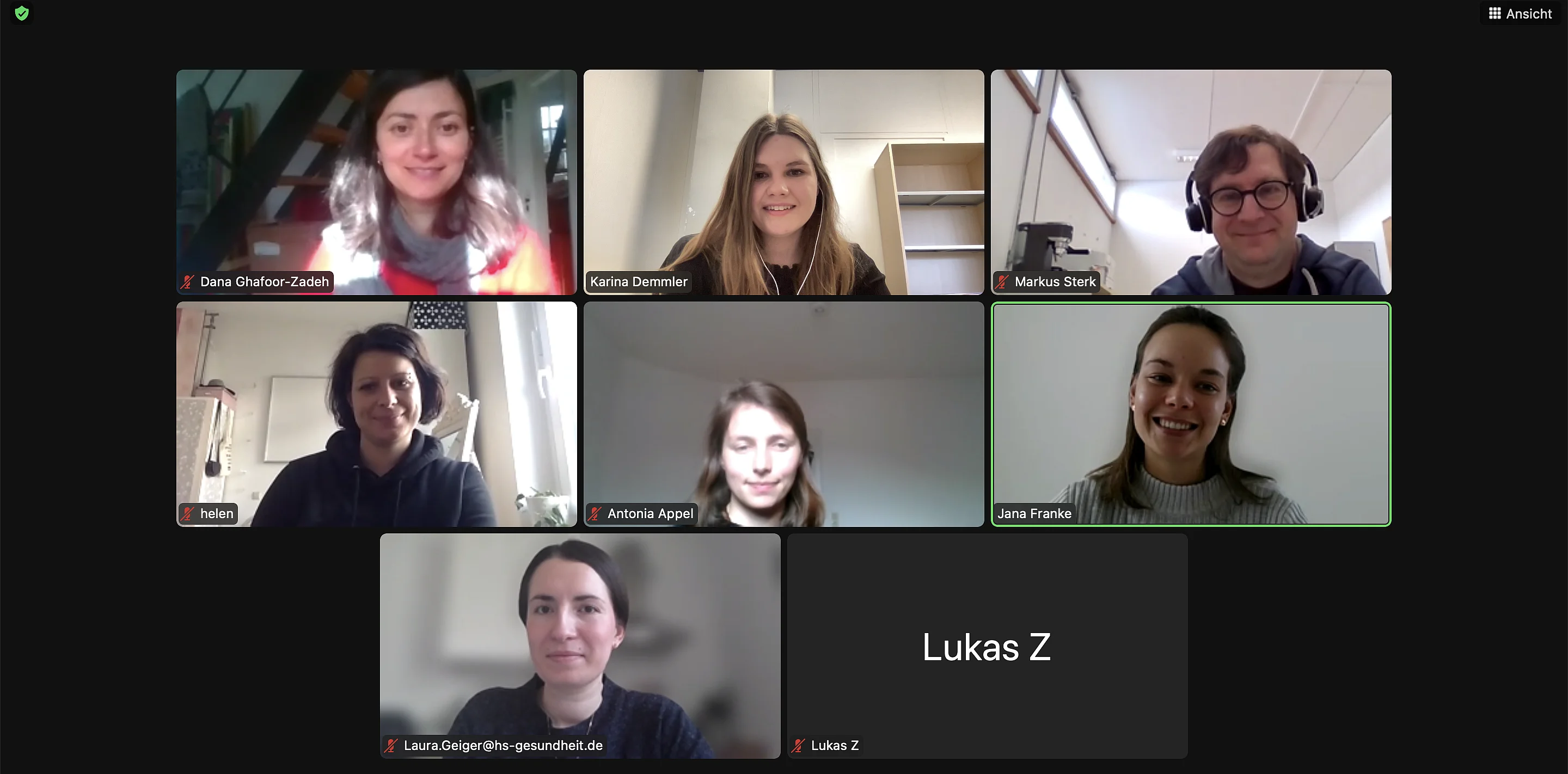
Doctoral Students' Council Meeting (February 2022)
News
Doctoral Students' Council Meeting
[Time and location will be updated in due course]
General Information
Everything at a glance: Flyer
Keep updated: join the mailing list
Doctoral studies at the University of Education Freiburg: Overview
What we offer
The Lunchtime Lectures are a joint format of the Prorectorate for Research and the Doctoral Students' Council. Four to five 15-minute presentations on topics relevant to doctoral students and early career researchers are given each semester. This is followed by an opportunity to ask questions and exchange ideas.
Further information on the individual Lunchtime Lectures and a list of topics from past Lunchtime Lectures can be found here.
After each Lunchtime Lecture, we go to lunch together—a great opportunity to talk to other doctoral students and discuss issues that concern doctoral students at the University of Education. We meet after each lunchtime lecture at 12:45 p.m. at the cafeteria entrance.
We meet every Friday starting at 9:00 a.m. for a writing workshop. Newcomers are always welcome. Just drop by—no registration required.
During the summer and winter semesters, we meet at the start of the lecture-free period. In addition, there is a writing week during the consultation week at the University of Education in the winter semester. For a whole week, we devote ourselves to writing every day from 8:45am to 3:30pm, which gives everyone the opportunity to work on papers, dissertations and submissions. Coffee and snacks are available to help keep us going.
A typical day during the writing week usually looks like this::
- 08:45: Arrival and coffee
- 09:00: Setting up and formulating writing goals
- 09:10: Three rounds of writing using the Pomodoro method (50 minutes of writing followed by a 10-minute break)
- 12:00: Lunch break
- 13:00: Coffee
- 13:30: Two rounds of writing using the Pomodoro method (50 minutes of writing followed by a 10-minute break)
- 15:30: Finish
The next writing weeks will take place as follows:
- 03-08 August 2026 (calender week 32)
- 12-16 October 26 (calender week 42)
We will announce the rooms via the usual channels (the “Early Career Academics” email distribution list, as well as the WhatsApp and Signal groups).
At least once per semester, we organise a get-together after work, which takes place at a venue in Freiburg. In the past, we have visited beer gardens or drunk mulled wine, for example. The date is announced via the mailing list and social media group.
If you are a doctoral candidate at the University of Education Freiburg and are interested in taking on a position, such as on a faculty council, please feel free to contact us at dokkonvent@ph-freiburg.de.
We also welcome ideas and suggestions as to what else we, as the Doctoral Students' Council, can do to support you or what other events we can plan within the framework of the Council.
Once per semester (January/July), we also hold our Doctoral Students' Convention meeting, where participants can exchange updates on current committee activities, discuss the needs and concerns of doctoral researchers, and plan future events. All doctoral researchers at the University of Education Freiburg are warmly invited to attend.
On the first day of our writing week during advisory week (Beratungswoche), we begin with a shared brunch to get to know each other before diving into an intensive week of writing. It's the perfect opportunity if you'd like to connect with other doctoral researchers and take part in the Writing Week (although, of course, you are welcome to join either activity independently). More detailed information will also be sent by email.
Support services offered by the University of Education
The Library is the central literature and information service provider for the University of Education and is open to all interested parties. It offers training courses and individual consultations on various topics, such as Citavi and referencing. Doctoral students can choose the appropriate training course depending on their level of knowledge and experience with the library's services.
Various institutions at the University of Education Freiburg cooperate under the umbrella of the Graduate Academy for Educational Sciences (BiwAk) with the aim of providing the best possible support to all researchers in the transition from undergraduate studies to doctoral studies, during the doctoral phase, the postdoctoral phase and on the path to professorship, including qualification, funding and counselling services.
The university certificate enables students, doctoral candidates and individuals intending to pursue a doctorate, as well as early-career researchers, to systematically acquire comprehensive research methodology skills. The courses and training elements that make up the certificate are designed based on the systematic combination of fundamental and applied research methodology knowledge.
The MenTa programm focuses on one-to-one mentoring between a female early-career researcher at the University of Education Freiburg (mentee) and an experienced, successful individual from academia, business, or an educational institution (mentor).
The QUASUS website is intended for students and teachers at the University of Education Freiburg who are interested in qualitative research in the fields of sociology, teaching and schools. It provides easy access to information on methods, as well as practical tools for independent research.
The Writing Centre is a student-run institution focusing on academic writing. It supports doctoral students in their writing process through consultations, workshops and writing groups, among other things.
The Department of University Didactics - Teaching Innovation - Coaching is an advisory and networking institution with the task and objective of contributing to the continuous improvement of study conditions in general and teaching in particular. Doctoral students are supported in their teaching activities through the following services, among others:
- University teaching training as part of the programme ‘Basic Certificate in University Teaching in the Context of Diversity-Sensitive Teaching and Learning’ (in collaboration with the Department of Gender Equality, Academic Staff Development & Family Support)
- Promotion of exchange among teachers
- University teaching consultations, including individual and team coaching
- Moderation activities, e.g., in structure-building measures, goal-setting processes, or conflict situations
- Establishment of internal and external collaborations
Getting accepted as a doctoral candidate
Before starting your doctorate, you must attend a doctoral candidate interview. Here you will receive a lot of information and have the opportunity to ask questions.
To arrange an appointment, please email forschung(at)ph-freiburg.de.
- Application for admission review: This document can be found on the wAcademic Career/Doctorate page. The title and doctoral committee are specified in the document.
- University transcript (certified): To be admitted to a doctoral programme, you must have completed a standard period of study of eight semesters and have an 'above-average' degree.
The documents are submitted to the faculty office.
You will receive notification of the result by post. You will need this notification for the next step: the 'Application for Acceptance'.
The application for acceptance is relatively extensive and is submitted to the relevant faculty's council. Submission deadlines vary between faculties, so you should check with the relevant dean's office secretariat.
The following documents are required:
- Application document: This can be found on the Academic Career/Doctorate page. This document also lists all the required documents.
- Doctoral Agreement: This agreement is discussed with the supervisors and signed by them and you. A template that can be adapted is available on the Academic Career/Doctorate page.
- Research proposal (digital and printed): A template to use as a guide is also available on the Academic Career/Doctorate page. The research proposal should be approximately 8–12 pages long.
- Affidavits: These could read as follows:
'I, [insert name], hereby declare that I have not previously attempted to obtain a doctorate, nor am I currently attempting to obtain one at any other academic institution.
Furthermore, I certify that I have not used and will not use the services of a commercial doctoral placement or consulting agency.' (Date/signature). - High school diploma (a copy is sufficient)
- Letter of admission (copy)
- Certificate of good conduct (original and current)
As a rule, you will receive notification of acceptance to the doctoral programme by post within a week.
Congratulations!
All members of staff at the University of Education can now ask themselves the 'status question'. On being accepted as a doctoral candidate, you have a one-time opportunity to change your status from ‘academic staff’ to 'Group B student'.
Being a student again
If you re-enrol as a student, you will have to pay the semester fee (currently €161), but you will also have a student ID card again, which means free travel on trams after 7 p.m., entitlement to a semester ticket, cheaper meals in the canteen and the usual student discounts (theatre, thermal baths, sports, etc.).
Academic self-administration at university
You can also become more involved in the status group of doctoral candidates at university level, which looks very good on your CV. This group is represented by the Doctoral Students' Convention. As an academic staff member, you automatically become a member of this group. However, you are not always eligible to vote in elections, nor can you fill individual positions on the university's committees, such as the faculty councils, senate and equality, inclusion and research committees. Consequently, some seats are currently vacant.
As an academic staff member, you officially belong to the academic mid-level faculty, which is entitled to fill committee seats. However, there are a large number of people in this faculty, and their concerns differ from those of doctoral candidates. This makes it difficult to make your own concerns heard.
Among doctoral candidates (i.e. students enrolled in a doctoral programme, as opposed to seconded teachers or academic staff pursuing their doctorates alongside their professional duties), only around 12 individuals currently possess voting rights. This is why you have more influence at the higher education policy level.
Conferences
There is usually a financial advantage to being a doctoral candidate at conferences and in organisations, as conference and membership fees (e.g. DGfE, GEBF, AEPF, EARLI) are often reduced.
If you want to change your status and become a student again, this will require some organisational effort. However, with a little preparation, it can be done quickly.
You will need the following documents to make the change:
- Insurance certificate: This takes some time, so you can apply for it in advance.
- Application for enrolment: You can obtain this application form from Ms Seither at the Registrars Office.
You can also obtain all the information you need on the following points here: - Transfer of the semester fee
- Declaration of change of status
- Declaration of change of tax status
- ZIK certificate: This will enable you to obtain your student ID card.
- Copy of the application for acceptance
All these documents should be handed in to Ms Seither at the Registrars Office. You will receive all further information by post.
Tips for successful completion of your doctorate
- Check out different copy shops in advance, compare them (e.g. in terms of price, service and quality) and choose the one that suits you best.
- If possible, plan the three-month assessment period for your dissertation during the lecture period (unless other arrangements have been made with your examiners).
- Bear in mind that defences usually take place during the lecture period.
- Listen to other (public university) defences, participate in defence training
- Arrange speech training specifically for the defence with Dr. Sieglinde Eberhart
- Seek open dialogue with your supervisors to clarify the conditions and expectations
- Read the doctoral regulations so that you are familiar with them during the defence, especially if there are external examiners present who are not familiar with them.
Contact Persons
Chairs of the Doctoral Students' Council

Representative on Faculty Council I
Representative on Faculty Council II
Currently vacant